
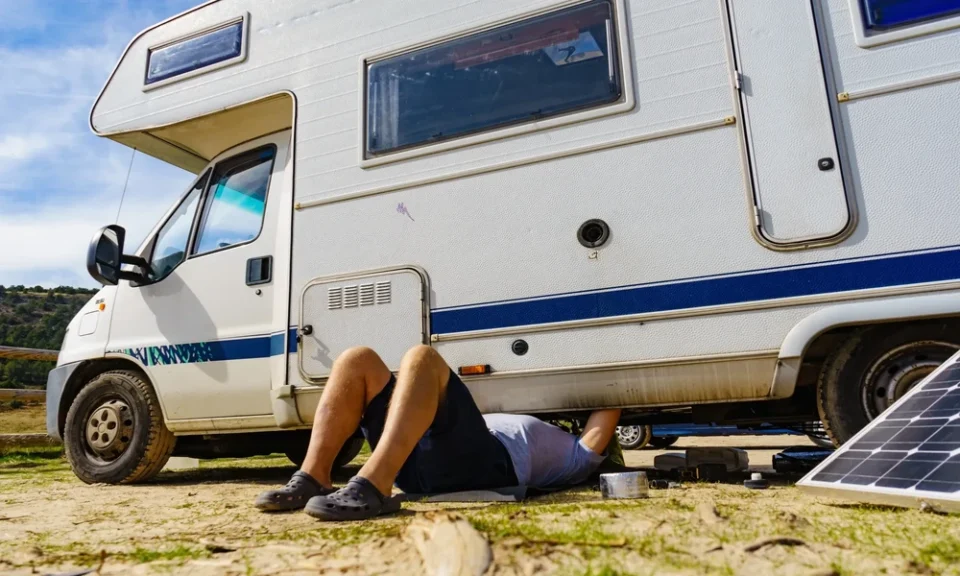
Half of the repair tickets that roll into a shop aren’t mystery failures. They’re the same five components quitting in the same order, over and over.
That’s the good news, because a predictable failure pattern means you can diagnose most problems before you ever call anyone. You just need to know which parts carry the load in a camper and which ones give up first. Spend twenty minutes reading this and you’ll walk out to your rig with a plan instead of a guess.
Here’s the short version. RV appliances fail in a rough sequence: power supply first, then igniters and thermocouples, then control boards, then the big sealed components like compressors and cooling units. Any Denver camper appliance repair shop sees that order play out weekly, and you can use it as a diagnostic ladder. Start at the top, work down, and stop when you find the broken rung.
Why campers break differently than houses
A house appliance sits still. Your camper appliance gets shaken down I-70, baked at 9,000 feet, and run on power that’s sometimes clean and sometimes not.
Vibration loosens connections. Altitude changes how propane and air mix. Shore power at a campground pedestal can sag below what a residential fridge or furnace expects. Every one of those conditions shortens the life of the parts that handle electricity and ignition.
So when your fridge stops cooling in Buena Vista but worked fine in your driveway, that’s not random. It’s the environment doing exactly what it does.
I’d take a camper with a thirty-year-old absorption fridge over a brand-new compressor unit for a boondocking trip, honestly. Fewer electronics, fewer things to fail. The tradeoff is slower cooldown, and I’ll make that trade every time.
What fails first, in the order it fails
Run this list top to bottom. Each step rules out everything above it.
- Batteries and charging. Most “appliance failures” are voltage problems. If your house battery dips below about 12 volts under load, the fridge, furnace blower, and control boards all act broken when they aren’t.
- Fuses and breakers. Cheap, fast, and embarrassingly common. Check the 12-volt fuse block and the 120-volt breaker panel before you touch anything else.
- Igniters and thermocouples. Gas appliance that won’t light or won’t stay lit? Usually the spark or the flame sensor, not the burner.
- Control boards. These live in a hot, vibrating box and they die early. If power and ignition are fine but nothing behaves, the board is the suspect.
- Sealed components. Cooling units, compressors, heating elements. Expensive, rare, and the last thing you should replace.
Work that order and you’ll solve most problems before step five. Skip it and you’ll buy a control board when you needed a ten-dollar fuse.
An absorption fridge that warms up
This is the most common call in Colorado, and it has a clean decision path.
First, confirm the rig is level. Absorption cooling depends on a fluid cycle driven by heat, and if the camper sits off-level long enough, that fluid stops circulating. Park on a slope overnight and you can cook the cooling unit for good. That’s not a repair, that’s a replacement.
Next, feel the back of the fridge through the outside access panel. Warm coils and a cold box? The unit’s working and your problem is airflow or a door seal. Cold coils and a warm box? The cooling unit is likely gone.
Then check propane pressure and the burner flame. A weak yellow flame points at the regulator or a dirty orifice, both cheap fixes. A strong blue flame with a warm box points at the cooling unit. That one hurts.
If you’re chasing this at 11 p.m. before a trip, just call it. The RV Industry Association tracks this segment because absorption failures are the single biggest service category in the industry, and shops see it daily.
Furnace problems show up as blower noise
Listen before you open anything. The furnace tells you where it’s stuck.
No blower at all means power or the sail switch. Blower runs, no ignition means the igniter or gas supply. Fires up and shuts down after thirty seconds means the flame sensor isn’t proving flame, or the exhaust is blocked.
That last one deserves a hard stop. A restricted exhaust on a propane appliance pushes combustion gases back into the living space, and carbon monoxide doesn’t care that you’re on vacation. The National Fire Protection Association maintains the standards your furnace and water heater were built around, and that’s the reason a blocked exhaust isn’t a wait-and-see situation.
Clear the exhaust, check the intake, and if it still cycles, stop guessing and get it looked at.
Water heater, microwave, and the quiet failures
| Appliance | First suspect | Second suspect | Typical DIY fix? |
|---|---|---|---|
| Water heater | Thermostat or ECO switch | Heating element (electric) or orifice (gas) | Sometimes |
| Microwave | Door interlock switch | Fuse or control board | No, never open it |
| AC unit | Capacitor | Compressor | Capacitor, yes |
| Range or oven | Igniter | Gas valve | Usually |
Water heaters are mostly thermostat problems and mostly easy. Microwaves are the opposite. A microwave’s high-voltage capacitor can hold a lethal charge long after it’s unplugged, and no blog post is worth that risk. If your microwave dies, replace it or have it replaced.
AC capacitors are the sweet spot. If your roof unit hums and won’t start, a capacitor is often a twenty-minute swap and a cheap part, and it’s the one repair I’d genuinely encourage a handy owner to attempt.
Where your power actually comes from
Worth understanding, because half the “failures” in this article trace back to it.
The Department of Energy publishes broad guidance on how electrical loads and efficiency work in homes and small buildings, and the same principles apply inside a camper. Everything you plug in competes for the same limited supply. Run the microwave, the AC, and a hair dryer on a 30-amp pedestal and something is going to fail, usually a breaker.
Know your rig’s amp rating. Know which appliances are 12-volt and which are 120-volt. That single distinction solves a surprising number of problems before they start.
When to stop and hand it off
Draw the line at these four.
- Anything involving propane lines you can’t easily inspect.
- Any appliance that cycles on and off and you’ve already replaced two parts.
- Cooling units, compressors, and sealed systems.
- Anything electrical where you can’t explain why a part failed.
Two parts replaced with no result usually means you’re treating a symptom, and the third part you buy is the one that costs real money. That’s the point where expert eyes beat another guess.
The question to ask yourself first
Not “what’s broken,” but “is this the same failure I had last season?” Repeats point to a root cause you haven’t found. New failures point to wear.
Answer that honestly and you’ll save yourself a parts budget and a ruined trip. Start with power, work down the ladder, stop at the first real failure, and know your four limits. Everything above that line, you can handle in a campground with a multimeter and an hour of patience.
What’s your rig doing right now?
